Performance Max vs Search Campaign: How to Choose the Right Google Ads Strategy
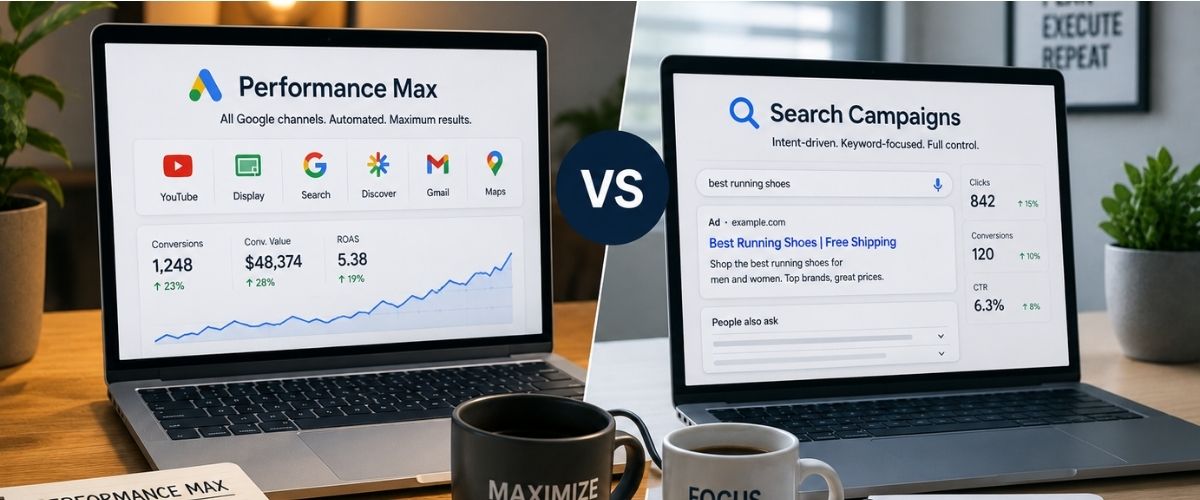
If you've spent any time inside Google Ads lately, you've probably hit this question. Do you run a Search campaign or go with Performance Max? Both sit inside the same platform. Both can generate leads. But they work in very different ways, and picking the wrong one can burn through your budget fast.
This post breaks down what each campaign type actually does, where each one works best, and how to work out which one fits your situation.
What Is a Google Search Campaign?
A Search campaign is the original Google Ads format. You pick your keywords, write your ads, and they show up when someone searches for those terms on Google. That's basically it.
You're targeting people who are already looking for something specific. Someone types "emergency plumber Sydney" and your ad appears. The intent is right there in the search. That's what makes Search campaigns reliable for businesses that sell a specific service or product.
With Search, you stay in control. You choose the keywords. You write the headlines and descriptions. You set the bids. You decide which landing page people land on. Nothing happens without you deciding it first.
What Is a Performance Max Campaign?
Performance Max, often called PMax, is a newer campaign type that Google launched more broadly in 2021. It works completely differently from Search.
Instead of targeting specific keywords, you give Google a set of creative assets. This includes headlines, descriptions, images, videos, and logos. Google then uses machine learning to show your ads across all of its networks. That means Search, YouTube, Display, Gmail, Discover, and Google Maps, all from one campaign.
Google decides where to show your ads, who to show them to, and how to combine your assets. You give it a conversion goal and the algorithm figures out the rest. You give up most manual controls in exchange for wider reach.
How Search Campaigns Work
Search campaigns work because they match intent. When someone searches for your service, they're already in buying mode. They came to Google with a need, and your ad is there when they look.
This makes Search a strong option for service businesses. If you run a law firm, a dental clinic, or a trade business, the people clicking your ads are usually pretty far along in their decision. They want a quote or they're ready to book. Traffic quality from Search tends to be higher for that reason.
You also get proper data. You can see exactly which keywords are driving clicks, which ones are converting, and which ones are costing money without results. You can pause bad keywords, adjust bids on good ones, and test ad copy over time. That level of visibility is hard to match.
How Performance Max Works
Performance Max takes a different approach. You're not picking keywords. You're uploading assets and setting a conversion goal. The algorithm handles placement, audience, and asset combinations.
PMax can show your ads in places Search never reaches. Someone watching YouTube might see your ad. A Gmail user might see it in their promotions tab. A person browsing a news site might see a display banner. That cross-channel reach is the main draw, especially for businesses that want to scale beyond Search.
The catch is limited visibility into what's happening. PMax reporting has improved but still doesn't show you which specific placements or asset combinations are driving conversions. You're trusting the algorithm. Some businesses are fine with that. Others find it frustrating when they want to cut waste and tighten up spend.
When Search Campaigns Make More Sense
Search tends to be the better starting point for most businesses:
- You're new to Google Ads: Search gives you control and clear data while you're still learning what works.
- You sell a high-intent service: Trades, legal, medical, and local services do well on search because people search with specific intent.
- Your budget is tight: When you have less to spend, you want every dollar going toward people actively looking for you. Search does that better.
- You need keyword-level data: Search shows you exactly what queries are converting. PMax does not.
- You don't yet have 30+ conversions per month: PMax needs conversion history to optimise properly. Without it, the algorithm is guessing.
When Performance Max Makes More Sense
PMax is not for every business, but it does have its place:
- You already have solid conversion data: Google recommends at least 30 to 50 conversions per month before PMax can learn properly.
- You want to scale beyond Search: If your search campaigns are already performing and you want more reach, PMax opens up YouTube, Display, and other placements without managing separate campaigns.
- You run an e-commerce business: PMax was partly built with e-commerce in mind. Shopping ads are included, and for product-based businesses with a feed, it can work well.
- You have good creative assets: Strong images and videos give the algorithm something useful to work with. Weak assets produce weak results.
- You want cross-channel retargeting: PMax can reach past visitors across multiple placements, which helps during longer buying cycles.
Running Both at the Same Time
Running both campaigns is possible. But there's something worth knowing: if a keyword triggers in both campaigns, PMax generally wins the auction. That means Search might see lower impression share where PMax is active.
A common setup is to keep Search campaigns for your highest-converting keywords and let PMax handle broader discovery and retargeting. You hold control where it matters most while still getting the wider reach.
Negative keywords also matter here. You can apply negative keyword lists at the account level, and they will affect PMax. Without them, PMax can show for searches that have nothing to do with your business, especially during the learning phase.
Common Mistakes to Avoid
Starting with PMax too early: Without enough conversion data, the algorithm has nothing to learn from. It ends up spending on placements that don't convert. Build conversion history with Search first.
Feeding PMax weak assets: If your headlines are dull, your images are generic, and you have no video, PMax will still run. The results will just reflect what you gave it.
Skipping audience signals: You can give PMax audience signals as a starting guide. It doesn't lock targeting, but it gives the algorithm a nudge toward the right people. Skipping this slows down the learning phase.
Not checking search term reports: PMax does offer some search term visibility now. When you have access to it, check it. You might find spend going toward queries that are completely off-target.
Dropping Search too early: Some advertisers see PMax volume and assume they no longer need Search. But Search drives high-intent traffic that PMax doesn't replicate as well. Cutting it usually hurts lead quality.
Conversion Tracking: The Part Most People Overlook
Both campaign types need accurate conversion tracking to work. For Search, good tracking tells you which keywords and ads produce real results. For PMax, it's even more important because the algorithm optimises entirely around your conversion signals.
If tracking is broken or incomplete, PMax will optimise toward the wrong thing. It might drive clicks that register as conversions but aren't actual sales or qualified leads. Before running either campaign type at any real spend, make sure your conversions are firing correctly and tied to real business outcomes.
Bad tracking is one of the most common reasons Google Ads campaigns underperform, regardless of which campaign type is running.
Finding the Right Setup for Your Business with Karma Media
Search and PMax both have real use cases. Most service businesses do better starting with Search and adding PMax once they have the conversion data to support it. Ecommerce businesses and those wanting cross-channel reach often get more out of PMax sooner.
At Karma Media, we work with businesses across Australia to build Google Ads setups that fit where they actually are, not just what looks good on paper. If you want someone to look at your current campaigns and work out what's worth keeping, book a free strategy session and we'll go through it with you.
.jpg)
.jpg)